


Understanding Trauma Part 2: Understanding the Three Brain Systems
Updated: Jul 9

The Thinking Brain: Your Inner Problem Solver
As we continue exploring the three brain systems, we'll begin with the thinking brain, the part responsible for reasoning, planning, and conscious decision-making.
Imagine you’re trying to complete a difficult puzzle.
You analyse the pieces.
You consider different possibilities.
You plan your next move.
You stay focused on the task until everything begins to fit together.
This ability comes largely from a remarkable area of the brain called the prefrontal cortex, often referred to as the brain’s executive centre.
The prefrontal cortex helps us:
think logically
plan ahead
make decisions
regulate emotions
solve problems
communicate through language
understand other people’s perspectives
reflect on our own behaviour
resist impulses
focus our attention
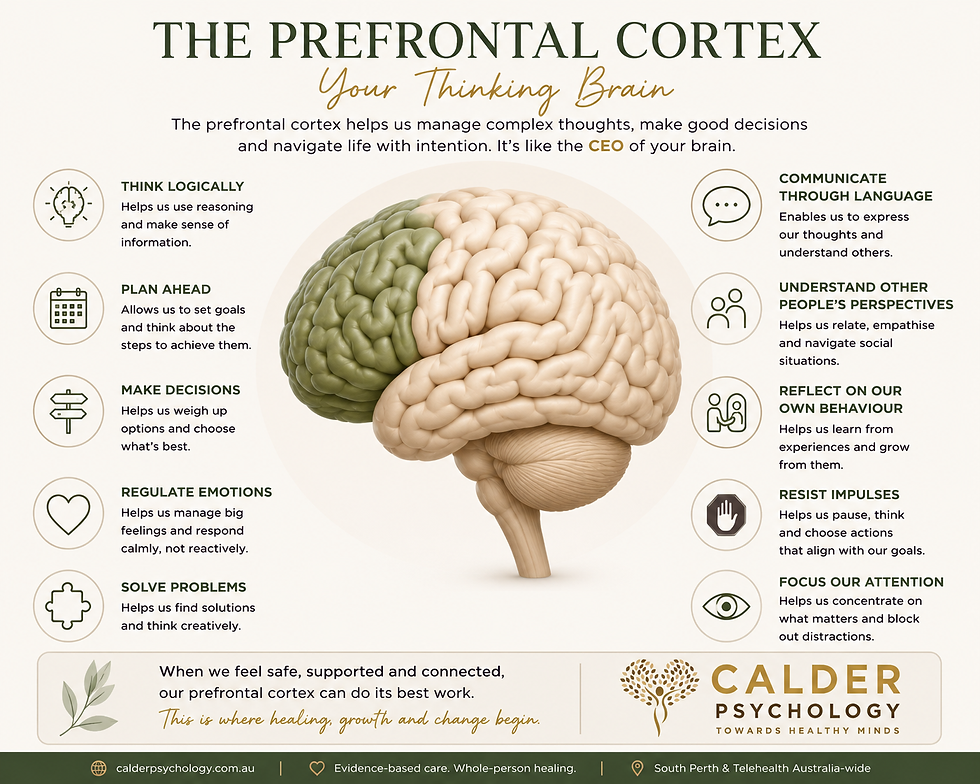
If you've ever wondered what controls thinking in the brain, the prefrontal cortex plays one of the most important roles in managing these higher-level cognitive functions.
In many ways, it acts like the chief executive officer (CEO) of the brain.
It gathers information from different systems, weighs up options, considers consequences, and helps us respond thoughtfully rather than react automatically.
When we feel calm, rested, and safe, the thinking brain performs remarkably well.
It allows us to pause before speaking.
To consider different perspectives.
To regulate frustration.
To make thoughtful decisions rather than impulsive ones.
To learn new skills and adapt to life’s inevitable challenges.
Many evidence-based psychological therapies work particularly well when this part of the brain is readily accessible.
These include:
Cognitive Behavioural Therapy (CBT)
Acceptance and Commitment Therapy (ACT)
Dialectical Behaviour Therapy (DBT)
Psychoeducation
Journalling
Self-reflection
Goal setting
These approaches can help us recognise unhelpful thinking patterns, develop healthier coping strategies, strengthen emotional awareness, and build psychological flexibility.
For many people experiencing mild to moderate anxiety, depression, stress, or life transitions, these therapies can be incredibly effective.
However, there is one important limitation.
The thinking brain only functions at its best when the nervous system feels relatively safe.
Why Insight Alone Isn’t Always Enough
Many clients arrive at therapy feeling frustrated.
They often say things like:
“I know my fears don’t make sense.”
“I understand where my anxiety comes from.”
“I know I shouldn’t react like this.”
“I understand everything you’ve explained, but I still can’t stop it.”
This can leave people feeling defeated.
They begin to question themselves.
“Maybe I’m not trying hard enough.”
“Maybe therapy doesn’t work for me.”
“Maybe I’m beyond help.”
Fortunately, neuroscience offers a much more compassionate explanation.
Imagine trying to have a thoughtful conversation while the fire alarm in your house is sounding at full volume.
Technically, you can still hear someone speaking.
But your brain isn’t interested in analysing complex ideas.
Its priority has changed.
Your attention immediately shifts towards safety.
The same thing can happen inside the brain.
When the nervous system perceives danger, whether that danger is real, remembered, or anticipated, the brain automatically reallocates its resources.
Instead of prioritising learning, reasoning, or reflection, it prioritises survival.
This isn’t a flaw.
It’s one of the most sophisticated protective systems ever developed.
What does the research say?
Research has shown that chronic stress can alter communication between brain regions involved in emotion regulation, memory, attention, and executive functioning. This helps explain why people experiencing prolonged stress or trauma often report difficulties with concentration, decision-making, and emotional regulation (McEwen, 2007).
The Emotional Brain: Where Experience Becomes Meaning
If you've ever asked what part of the brain affects emotions, much of the answer lies within the limbic system, which helps shape our emotional experiences, memories, and relationships.
Beneath the thinking brain lies a collection of structures often referred to as the limbic system.
If the prefrontal cortex is the brain’s chief executive, the limbic system could be thought of as its emotional interpreter.
Its role isn’t simply to generate feelings.
It helps determine what experiences mean to us.
This system is involved in:
emotions
memory
motivation
attachment
learning
relationships
reward
emotional significance
Think about hearing a song you haven’t listened to for twenty years.
Within seconds, you may be transported back to a specific moment in your life.
Perhaps you remember where you were.
Who you were with.
How you felt.
The memory isn’t only cognitive.
It’s emotional.
That’s because emotional experiences are stored differently from factual information.
The limbic system helps connect memories with feelings, relationships, and meaning.
This is one reason why emotionally significant experiences, whether joyful or distressing, can continue to influence us long after they have occurred.
Why Trauma Doesn’t Always Feel Like a Memory
When most people think of memory, they imagine recalling events like watching a movie.
Traumatic memories often don’t work that way.
Instead of simply remembering what happened, people may re-experience aspects of the event through emotions, body sensations, smells, sounds, or automatic reactions.
A crowded shopping centre.
A particular tone of voice.
The smell of smoke.
A sudden loud noise.
An argument.
Without consciously deciding to, the emotional brain may interpret these experiences as reminders of past danger.
This can activate intense emotional responses before the thinking brain has had an opportunity to evaluate whether the present situation is actually safe.
Understanding this helps explain why trauma survivors often say:
“I know I’m safe, but it doesn’t feel like it.”
That statement makes perfect sense when we understand how the emotional brain works.
Supporting the Emotional Brain
Unlike the thinking brain, the emotional brain doesn’t respond particularly well to logic alone.
Imagine trying to convince a frightened child that there is “nothing to worry about.”
Facts may help, but what often helps even more is feeling understood, supported, and safe.
The emotional brain works in much the same way.
This is why many trauma-informed therapies focus not only on insight, but also on helping people process unresolved emotional experiences.
Evidence-based approaches that commonly support emotional processing include:
Eye Movement Desensitisation and Reprocessing (EMDR)
Schema Therapy
Attachment-focused therapy
Compassion-focused approaches
Mindfulness-based interventions
Emotion-focused strategies
These therapies don’t erase difficult memories.
Instead, they help reduce the emotional intensity attached to those memories, allowing people to remember their experiences without continually reliving them.
Over time, many people notice they are no longer reacting to present-day situations as though they are still trapped in the past.
In Part 3, we’ll explore perhaps the most fascinating—and often misunderstood—part of the brain: the Survival Brain. It is the final component of the three brain systems we've been exploring throughout this series. We’ll examine why the body automatically shifts into fight, flight, freeze, or shutdown, why these responses are not signs of weakness, and how effective therapy can help the nervous system rediscover a sense of safety.


Comments