


Understanding Trauma Part 5: Can the Brain Really Change?

The Science of Neuroplasticity, Hope, and Lasting Healing
“Perhaps the most remarkable thing about the human brain isn’t how complex it is. It’s that it can continue changing throughout your life.”
What If Change Really Is Possible?
Perhaps you’ve wondered…
“Maybe this is just who I am.”
Or perhaps you’ve said to yourself,
“I’ve been like this for as long as I can remember.”
Maybe anxiety has been with you for decades.
Perhaps you’ve always struggled with self-doubt.
Maybe difficult childhood experiences continue to shape your relationships today.
Or perhaps you’ve experienced trauma that still feels as though it happened yesterday.
After living with these difficulties for years, it’s understandable to wonder whether meaningful change is truly possible.
Many people arrive at therapy carrying an unspoken fear:
“What if I’m permanently damaged?”
It’s one of the saddest beliefs a person can carry.
Fortunately…
Modern neuroscience offers a far more hopeful answer.
People also commonly ask, "What is psychological therapy?"
At its core, psychological therapy is a collaborative process that helps people better understand their thoughts, emotions, behaviours, and experiences while developing healthier ways of coping.
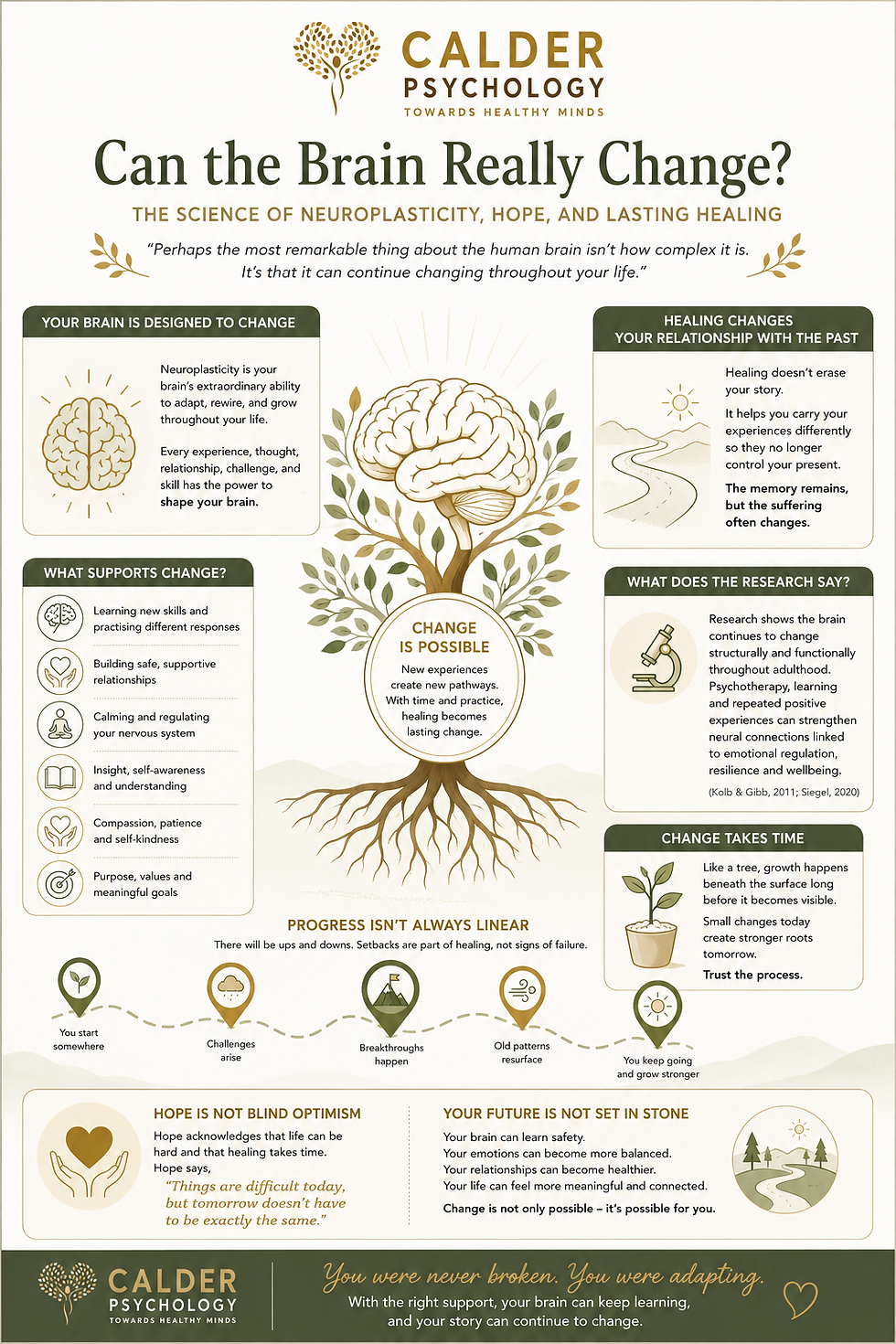
The Brain Was Never Designed to Stay the Same
For much of the twentieth century, scientists believed the adult brain was relatively fixed.
Once we reached adulthood, it was thought that our brain’s structure remained largely unchanged.
Today, we know something very different.
The brain is constantly adapting.
Every experience.
Every conversation.
Every new skill.
Every meaningful relationship.
Every challenge.
Every therapeutic breakthrough.
Each has the potential to reshape the connections between billions of neurons.
This remarkable ability is known as neuroplasticity.
What is neuroplasticity of the brain? It is the brain's remarkable ability to change, adapt, and form new neural connections throughout life.
Neuroplasticity is the brain’s ability to change throughout life.
Your Brain Is Always Learning
Whether we realise it or not, our brain is learning every day.
Sometimes it learns helpful things.
Sometimes it learns protective patterns that made sense at the time but are no longer serving us.
Imagine touching a hot stove.
You quickly learn not to do it again.
That’s neuroplasticity.
Now imagine growing up in an unpredictable environment.
Perhaps you learned to constantly scan for danger.
To expect criticism.
To avoid conflict.
To hide your emotions.
To put everyone else’s needs before your own.
These patterns weren’t weaknesses.
They were adaptations.
Your brain learned them because, at some point, they increased your chances of feeling emotionally or physically safe.
The remarkable news is this:
If the brain can learn protective patterns… it can also learn healthier ones.
Healing Doesn’t Mean Erasing the Past
This is one of the biggest misconceptions about therapy.
People sometimes imagine healing means forgetting painful memories or pretending difficult experiences never happened.
That’s not the goal.
Healing doesn’t erase your story.
Healing changes your relationship with your story.
You may still remember what happened.
But those memories no longer dominate your present.
Instead of feeling trapped by the past, you begin carrying it differently.
The memory remains.
The suffering often changes.
Every New Experience Changes the Brain
Think about learning to drive.
At first…
Everything feels overwhelming.
Mirrors.
Indicators.
Traffic.
Speed.
Pedestrians.
Parking.
Your brain works incredibly hard.
But after enough practice…
Driving becomes almost automatic.
Why?
Because your brain created stronger neural pathways through repetition.
Therapy works in much the same way.
Learning to notice emotions.
Setting healthy boundaries.
Responding differently during conflict.
Practising self-compassion.
Grounding yourself during anxiety.
Allowing yourself to trust safe people.
Each time you practise these new experiences, your brain is strengthening new pathways.
At first, they feel unfamiliar.
Eventually, they begin feeling natural.
What Does the Research Say?
Research demonstrates that the brain remains capable of structural and functional change throughout adulthood.
If you've ever wondered, "Does psychological therapy work?", decades of research show that evidence-based therapy can support lasting changes in brain function, emotional regulation, and behaviour. Learning, repeated experiences, and psychotherapy have all been associated with measurable changes in neural functioning, supporting emotional regulation, cognitive flexibility, and adaptive behaviour.
Understanding what neuroplasticity of the brain is helps explain why learning, repeated experiences, and psychotherapy can create meaningful changes in how the brain functions over time.
Learning, repeated experiences, and psychotherapy have all been associated with measurable changes in neural functioning, supporting emotional regulation, cognitive flexibility, and adaptive behaviour (Kolb & Gibb, 2011; Siegel, 2020).
Why Therapy Takes Time
People sometimes ask,
“How many sessions until I’m better?”
It’s a completely understandable question.
But lasting psychological change rarely happens overnight.
Imagine planting a tree.
You wouldn’t expect it to bear fruit the following morning.
Healthy growth takes time.
Roots develop beneath the surface long before visible changes appear.
Therapy often works similarly.
Some changes happen quickly.
Others unfold gradually.
You may notice:
responding more calmly
recovering from setbacks more quickly
feeling less overwhelmed
becoming kinder towards yourself
feeling more connected in relationships
recognising triggers earlier
experiencing greater confidence
These changes often develop quietly before people fully realise how far they’ve come.
Progress Isn’t Always Linear
One of the most important things to remember is that healing rarely follows a straight line.
Some weeks feel encouraging.
Others feel frustrating.
Old emotions may resurface.
Difficult memories may return.
This doesn’t necessarily mean you’re going backwards.
In fact…
Many people experience periods of discomfort immediately before meaningful breakthroughs.
Think of rehabilitation after a physical injury.
Muscles often feel sore before they become stronger.
Psychological growth can feel much the same.
Healing isn’t measured by never struggling again.
It’s measured by how differently you respond when life becomes difficult.
Hope Is Not Blind Optimism
Sometimes people hear the word hope and imagine being told,
“Everything will be fine.”
Real hope is something different.
Hope doesn’t ignore suffering.
Hope acknowledges suffering while believing change remains possible.
Hope says,
“Things are difficult today.”
and
“Tomorrow doesn’t have to look exactly the same.”
At Calder Psychology, we don’t believe in offering false reassurance.
Instead, we believe in something far more meaningful.
Evidence.
Research.
Compassion.
Experience.
And the remarkable capacity of people to heal when they receive the right support.
Healing Happens Through Relationships
Although neuroscience teaches us about neurons, networks, and brain systems…
Healing is rarely a purely biological process.
Human beings heal through relationships.
Feeling understood.
Feeling accepted.
Feeling emotionally safe.
Being able to share experiences without fear of judgement.
Having someone help make sense of overwhelming experiences.
These moments influence the brain in powerful ways.
This is one reason the therapeutic relationship itself is considered one of the strongest predictors of positive therapy outcomes across many different treatment approaches.
Sometimes the most important thing therapy offers isn’t advice.
It’s a different emotional experience.
You Are More Than Your Diagnosis
Whether you’ve been diagnosed with:
Anxiety
Depression
PTSD
ADHD
Autism
Complex trauma
Chronic stress
Obsessive-Compulsive Disorder
or something else entirely…
Your diagnosis describes some of your experiences.
It does not define who you are.
You are far more than a collection of symptoms.
You are a whole person.
With strengths.
Relationships.
Dreams.
Values.
Challenges.
Experiences.
And the capacity to continue growing.
The Journey We’ve Taken Together
Throughout this series we’ve explored:
Part 1
Why therapy is about far more than simply talking.
Part 2
The Thinking Brain and Emotional Brain.
Part 3
The Survival Brain and why our nervous system protects us.
Part 4
Why different therapies support different aspects of healing.
And now…
Perhaps the most important message of all.
Your brain remains capable of change.
Your nervous system can learn safety.
Your emotional world can become more flexible.
Your relationships can become healthier.
Your future does not have to be dictated by your past.
A Final Thought
If you’ve read this entire series, perhaps one message stands above all the others.
You were never broken.
Your brain has been doing exactly what it believed it needed to do in order to help you survive.
Now…
With understanding.
Compassion.
Evidence-based therapy.
And the right support…
It can begin learning something new.
Not because your past didn’t matter.
But because your future matters too.
Healing isn’t about becoming someone different.
It’s about rediscovering who you are when survival is no longer running your life.
At Calder Psychology, we are privileged to walk alongside people as they take that journey.
If you’re ready to take the next step, we’d be honoured to support you.


Comments